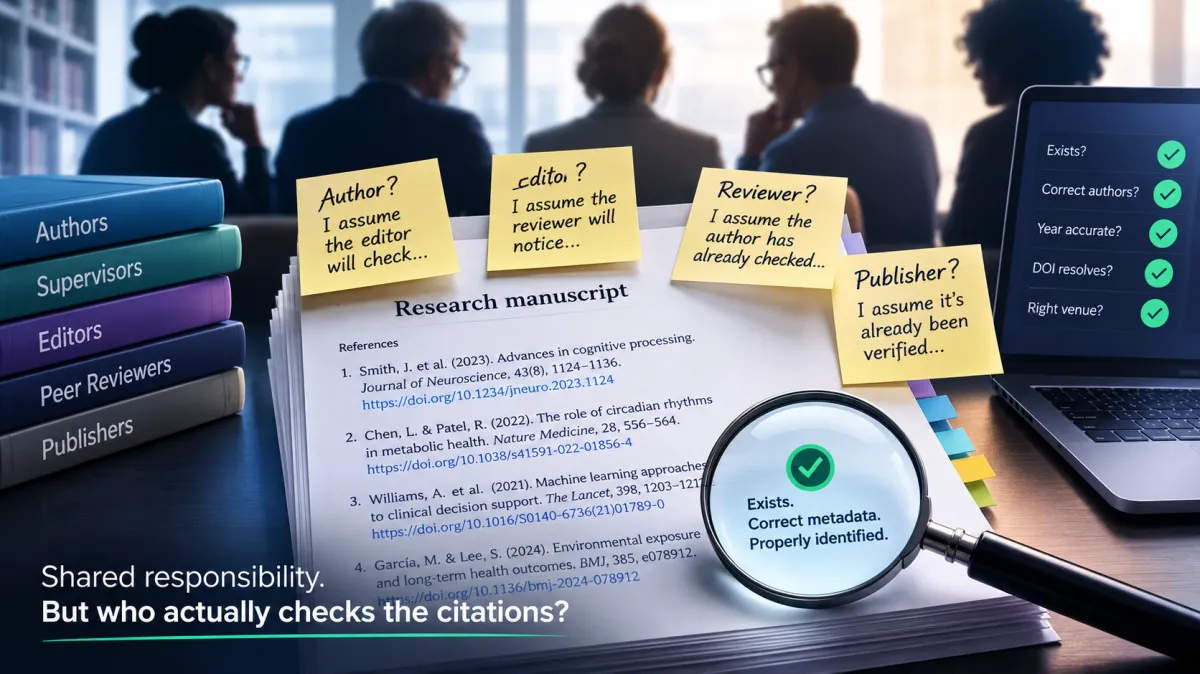
When Everyone Is Responsible for Citation Integrity, Who Actually Checks?
Academic integrity is everyone's responsibility.
But who actually checks the citations?
Not who is responsible for academic integrity in the broad sense.
Who performs the specific task of establishing that a cited source exists and that the bibliographic information supplied actually identifies that source?
Those are different questions.
And as producing plausible references becomes faster and easier, the distinction matters more.
Responsibility can exist without ownership
Consider a manuscript moving through a scholarly workflow.
The author, supervisor, editor, peer reviewer and production team may all have responsibilities for different aspects of its quality and integrity.
Each may act responsibly within the boundaries of their role.
And yet the citation itself may never be independently checked.
Nobody has necessarily failed to care.
The task may simply never have been explicitly assigned.
This is the difference between collective responsibility and operational ownership.
Academic integrity can be everyone's responsibility while citation verification remains nobody's defined job.
A shared principle is not a workflow
Organisations often rely on broad statements of responsibility.
Sources should be reliable.
Authors should check their work.
Editors should maintain standards.
Reviewers should identify problems.
These are reasonable expectations.
But principles do not perform tasks.
A functioning control requires something more specific.
Someone has to know that a check is required.
Someone has to perform it.
The check has to happen at an identifiable point in the workflow.
And there has to be some way of knowing that it happened.
Without those elements, responsibility can remain everywhere in principle and nowhere in practice.
Citation production has scaled. Citation verification has not.
Citation errors are not new.
References have always been mistyped, copied incorrectly, cited second-hand or confused with similar publications.
Generative AI did not invent inaccurate citations.
What it has changed is the production constraint.
Before generative AI, producing references at scale generally involved more human friction: searching databases, copying citations, importing records, reading papers or encountering references through existing literature.
Today, plausible references can be suggested or generated almost instantly.
That changes the balance.
Citation production has scaled. Citation verification has not.
The amount of human attention required to verify a reference has not fallen simply because the time required to produce one has.
A bibliographic record still has to be located.
Authors, titles, publication details and identifiers still have to be compared.
Ambiguous cases still require judgement.
The result is a growing mismatch between the speed at which references can enter scholarly work and the capacity to check them.
That mismatch becomes particularly important when ownership of verification is already unclear.
The problem is larger than hallucination
Much of the discussion about AI and citations focuses on hallucinated references.
That is understandable. A completely fabricated paper with a plausible title and nonexistent DOI is an obvious failure.
But building the entire discussion around hallucination risks missing the more durable issue.
Models will improve.
Retrieval systems will improve.
Reference managers will add safeguards.
Different tools will make different kinds of errors.
A citation does not have to be entirely fabricated to be wrong.
The source may exist but have the wrong author. The title may belong to a different paper. The year may be incorrect. The DOI may resolve to another publication. The metadata may combine elements from multiple real sources.
And none of these problems depends entirely on generative AI.
The more durable principle is therefore:
Whatever produced the citation, somebody must verify the citation.
It may have come from a language model, a database, another paper, a research assistant or memory.
The source of the citation changes the risk profile.
It does not remove the need for verification.
What exactly should someone own?
Citation verification needs a narrow definition.
It does not mean deciding whether a paper's conclusions are correct.
It does not mean establishing whether the methodology is sound.
It does not mean proving that a cited source supports the claim for which it is being used.
Those are separate questions requiring different forms of expertise and judgement.
Citation verification begins with something more basic:
Does the source exist, and does the supplied bibliographic information accurately identify it?
Does the title match a reliable bibliographic record?
Are the authors correct?
Is the publication year accurate?
Does the DOI resolve to the source being cited?
Is the journal or publication venue correct?
Is enough information available to identify the work reliably?
In short: does the reference point to a real, correctly identified source?
A citation that passes those checks may still be misused.
But a citation that fails them has a problem before anyone begins evaluating what the source actually says.
That is why citation verification deserves to be treated as a distinct task rather than an assumed by-product of other scholarly controls.
The verification boundary
Every reliable process has points where responsibility becomes explicit.
Someone approves the methodology.
Someone signs off on ethics requirements.
Someone submits the manuscript.
Someone makes the publication decision.
Citation verification needs similar clarity.
The precise location of that boundary may differ between workflows.
An author may verify references before submission.
An academic editor may include citation verification in a pre-submission review.
A university writing centre may teach students to perform a structured check.
A publisher may introduce systematic screening before peer review or production.
There is no reason to assume that one model will fit every institution or discipline.
But four questions should be answerable:
Who owns citation verification?
When does it happen?
What exactly is checked?
How do we know the check occurred?
Until those questions have clear answers, citation integrity remains vulnerable to the gap between collective intention and operational reality.
Verification should not depend on suspicion
There is another weakness in relying on diffuse responsibility.
People tend to investigate references when something looks wrong.
A strange title.
An unfamiliar journal.
A DOI that does not resolve.
A citation that feels out of place.
But plausible references are precisely the difficult ones.
A fabricated or mismatched citation may look entirely ordinary.
The authors may be real.
The journal may exist.
The title may sound appropriate.
The formatting may be perfect.
Nothing about the reference necessarily announces that it needs investigation.
A system that verifies citations only when someone becomes suspicious therefore depends on the error first becoming visible.
That is not a verification process.
It is an exception process.
The question should not be: “Does this citation look suspicious enough to check?”
It should be: “Has this citation been checked?”
That is a much stronger control.
The goal is not to add another burden
Academic publishing already operates under significant pressure.
Researchers face growing workloads.
Reviewers contribute substantial labour.
Editors manage increasingly complex processes.
The answer cannot simply be to add another manual responsibility and hope someone finds the time.
The challenge is to make verification proportionate, efficient and clearly located.
Some checks can be automated.
Some cases will remain ambiguous.
Some will require human judgement.
The objective should not be perfect certainty.
It should be to move from assumed verification to visible verification.
That means checking what can be checked systematically, surfacing discrepancies clearly and reserving human attention for cases that genuinely require it.
Technology can help.
But technology does not decide who owns the outcome.
That remains an organisational question.
From collective responsibility to operational ownership
The academic system does not lack concern for integrity.
The harder problem is translating that concern into specific controls.
The lesson should not be that authors are irresponsible.
It should not be that reviewers have failed.
And it should not be that peer review is broken.
The more useful conclusion is that a task can fall between responsible people when nobody explicitly owns it.
Generative AI has made that gap harder to ignore.
Citation production has scaled. Citation verification has not.
Academic integrity may be a collective responsibility.
Citation verification still requires operational ownership.
The practical response is not to assign vague responsibility to everyone.
It is to define the task, locate it in the workflow and decide who is responsible for ensuring that it happens.
Whatever produced the citation, somebody must verify it.