The Half-Real Citation
Why a real source can still be a wrong citation, and why checking "does it exist?" isn't enough.
If you edit, coach, or review academic work, you already know the sinking feeling: a reference list that looks immaculate and a quiet suspicion that something in it isn't true.
Your instinct is right more often than you'd like.
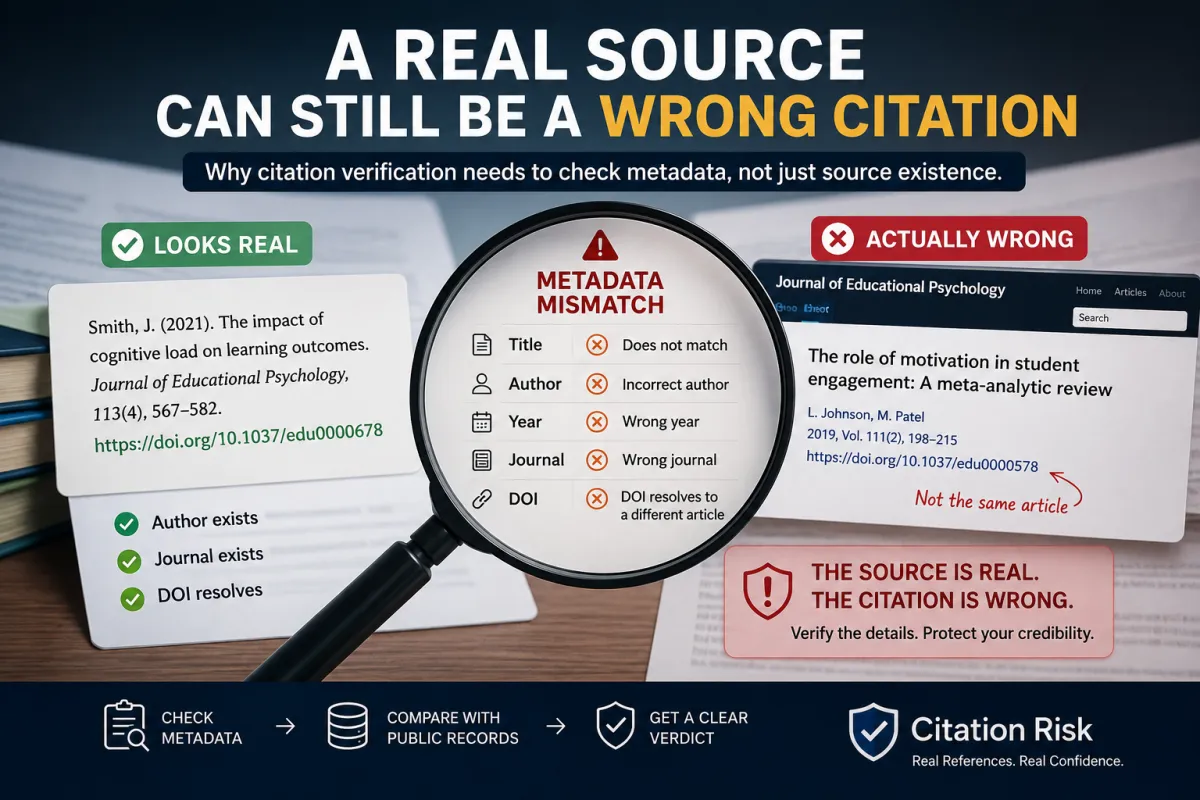
Here's the problem in one sentence: a citation can point to a real source and still be wrong. The article exists, the journal exists, the DOI resolves and the reference is still broken, because the details attached to it don't match the source they claim to describe.
Most people checking references stop at the first sign of existence. That's exactly where the danger starts.
Anatomy of a Half-Real Citation
Consider a reference like this one, a representative composite of the kind AI tools produce every day:
Novak, T., & Berger, L. (2021). Metadata integrity in machine-generated bibliographies. Journal of Scholarly Publishing, 52(3), 141–158. https://doi.org/10.3138/jsp.52.3.04
At a glance, nothing screams fake. The journal is real. The field is plausible. The DOI is correctly formatted and may even resolve. An author with a similar name may well have published on adjacent topics.
Now check the pieces against public bibliographic records, and the citation can fall apart one detail at a time. The DOI resolves, to a different article. The journal exists, but never published this title. The first author is real, but didn't write this paper. The year is plausible, for a paper that doesn't exist.
Every fragment is borrowed from somewhere real. The assembled whole describes nothing.
That's a half-real citation, and it's more dangerous than an obvious fabrication, because it gives the reviewer just enough confidence to move on.
The cleaner the citation looks, the less likely anyone is to question it.
Why AI Makes This Common
Language models don't retrieve references; they generate text that resembles references. A model has seen that certain authors write on certain topics, that certain journals publish in certain fields, that DOIs follow a particular pattern. So it produces citations that are structurally believable, real pieces of academic metadata recombined into something no database contains.
The result usually isn't a complete fabrication. It's worse: a reference that's 80% true, which means it survives a casual check and fails a real one.
And manual review is built for casual checks. Style guides get enforced, APA formatting, italics, alphabetization , while nobody confirms that the DOI points to the paper described. With fifty or a hundred references, even diligent reviewers sample rather than verify. AI generates citation errors at scale; manual review catches them slowly, inconsistently, or after submission.
That gap is where credibility dies. A wrong citation breaks the trust chain between reader and evidence, and the reader can't tell a careless error from a fabricated source. For a student, that's an integrity review. For a researcher, a peer-review embarrassment. For an editor or thesis coach, it's your client discovering the problem after you signed off on the document.
Catch it before your client does. Better yet, before the document leaves your desk.
What Real Verification Checks
A proper citation audit doesn't ask "does something like this exist?" It compares the supplied reference against public bibliographic records and asks whether this citation accurately describes that source: Do the title, authors, year, and venue match? Does the DOI resolve, and does it resolve to the same paper the citation describes? Are volume, issue, and pages consistent?
Then it should give you a verdict you can act on, not vague reassurance. Four verdicts cover the core cases:
Verified. The source appears to exist and the key metadata matches. It can stay.
Mismatch. A likely source was found, but one or more supplied details are wrong. Correct it.
Not Found. No reliable matching source was located. Replace it or remove it, noting that "not found" means not found in the records checked, not proof the source exists nowhere.
Incomplete. The citation doesn't contain enough information to verify confidently. Get more before trusting it.
In practice, honest verification needs two more: Review, for cases where the evidence is genuinely ambiguous and a human should decide, and Lookup Limited, for when the databases themselves couldn't be fully queried. A tool that admits uncertainty is more trustworthy than one that fakes confidence, the whole point, after all, is that false confidence is the enemy.
What Citation Risk Does and Doesn't
This is the problem Citation Risk was built for. It checks whether supplied references appear to exist and whether their key metadata matches public bibliographic records, flagging fabricated citations, mismatched details, unresolved DOIs, and incomplete references, and returning the verdicts above.
Not a formatter. Not a source finder. Not AI fog.
And to be equally clear about the boundary: Citation Risk does not prove that a source supports the claim attached to it. A paper can exist, be cited perfectly, and still be misrepresented by the sentence that cites it. Claim-support checking is a separate, deeper layer of verification, but it's a layer you can't even reach until you know the citation itself is accurate.
Citation verification is the first gate.
The Bottom Line
A DOI that resolves is not always the right DOI. A real author does not prove the article exists. A polished reference list proves nothing except that someone, or something, knows what a reference list looks like.
If AI touched the references, they need to be verified, not just formatted.
Citation Risk is in early beta. Paste a reference list at citationrisk.com and see what a real citation audit looks like, before the document leaves your desk.