Publishers Are Finally Checking the References
For years, academic publishing ran on a simple assumption: if you cited a paper, you’d checked it. Authors did the verifying. Editors caught the occasional obvious error. Reviewers weren’t expected to resolve every DOI in a bibliography; that was never their job.
Generative AI didn’t change that responsibility. It changed how easily someone could fail to meet it without noticing. A convincing bibliography now takes seconds to produce, and the person producing it may never have opened a single paper on the list. Some references will be fine. Others will have the wrong year, the wrong journal, a DOI that doesn’t resolve, or a paper that simply doesn’t exist.
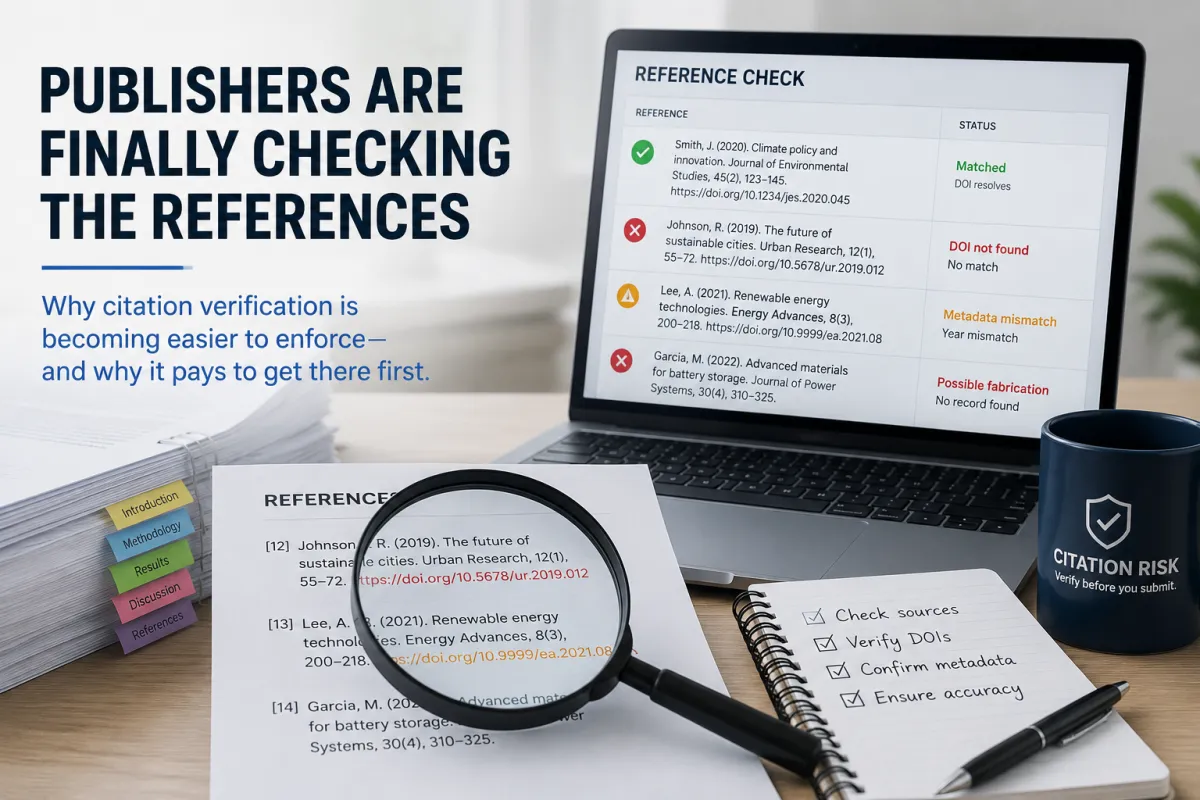
Publishers are starting to respond with more automated checks inside submission and research-integrity workflows. That changes where citation problems are likely to be found. Authors are no less responsible for what they submit, but publishers are becoming better equipped to check whether the references in front of them are real and accurately described.
For authors, academic editors and thesis coaches, the practical consequence is straightforward: a citation problem found before submission is an editing problem. The same problem found after submission may mean a correction request, additional scrutiny or a delay while the reference is resolved.
Who finds the error matters.
This is the gap Citation Risk is designed to check. It compares supplied citations with reliable bibliographic records and looks at whether key metadata agrees with those records.
Suppose a manuscript cites a real paper but gives the wrong publication year. Or the DOI in the reference resolves successfully, but to a different article. Both citations can look perfectly plausible during a quick read. Citation Risk can identify the mismatch and show the bibliographic evidence behind the result before the manuscript is submitted.
There is an important limit to that verification.
It does not establish that the cited paper supports the author’s claim. A reference can be completely accurate, real paper, valid DOI, correct metadata and still be poor or inappropriate evidence for the argument being made.
That requires a different kind of review, and Citation Risk does not currently claim to provide it.
The narrower question is becoming much easier to enforce: does this source exist, and has it been cited accurately?
For years, scholarly publishing largely depended on authors having answered that question themselves.
Publishers are increasingly building the means to check.
The sensible place to discover the problem is still before the manuscript reaches them.