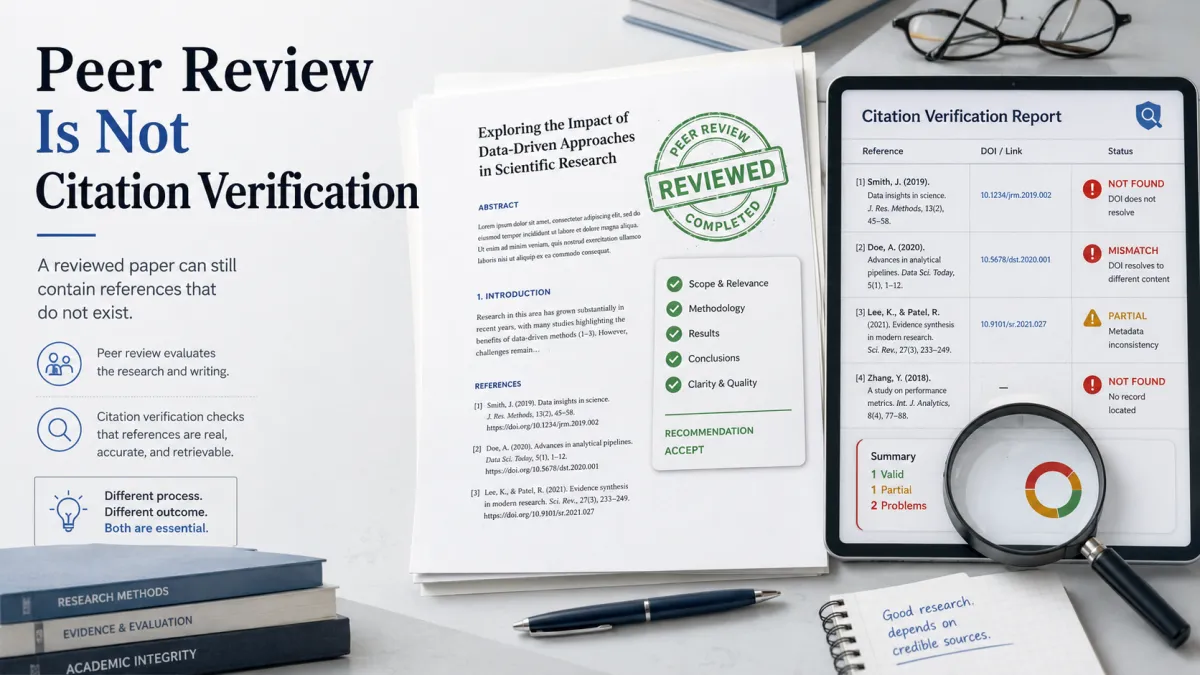
Peer Review Is Not Citation Verification
A paper can be peer reviewed and still contain references that do not exist.
That is not a theoretical risk.
In May 2026, the Journal of Medical Ethics, published by BMJ Group, retracted an article after investigating concerns about the quality of the work and the accuracy of its references.
According to the retraction notice, several references did not exist. The investigation also found that the author had used generative AI to identify and understand referenced sources but had not verified those references before submitting the article.
The author agreed to the retraction. The notice also referred separately to evidence of peer-review manipulation, although BMJ Group did not publicly provide further details about that issue.
It would be easy to treat this as another story about AI hallucinating references.
But the more important lesson is about the publication workflow.
The problem was not simply that generative AI was used.
The problem was that references suggested or interpreted through AI entered a manuscript without an independent verification step—and remained there through submission and publication.
The wrong lesson: never use AI to find sources
Generative AI can help researchers explore terminology, identify possible authors, understand unfamiliar subjects and generate starting points for a literature search.
But a suggested source is not necessarily a real source.
Language models are designed to generate plausible text. Bibliographic references have predictable structures: author names, article titles, journal names, publication years, volume numbers and DOIs.
That structure makes citations relatively easy to imitate.
A generated reference can look completely legitimate while containing:
an invented article title;
a real author attached to the wrong paper;
an incorrect publication year;
a journal that never published the article;
an invalid or fabricated DOI;
or a source that does not exist at all.
The practical rule should not be that researchers must never use AI during source discovery.
It should be:
Any citation identified, reconstructed or supplied through generative AI must be treated as unverified until it has been checked against reliable bibliographic records.
AI can suggest where to look.
It cannot be treated as the record itself.
What should have happened
A responsible AI-assisted research workflow should contain a clear verification gate:
AI suggests a source
↓
The source is located in a reliable bibliographic record
↓
The title, authors, year, journal and DOI are compared
↓
Any discrepancy is corrected or the citation is removed
↓
Only then does the reference enter the final manuscript
Without that gate, plausibility can be mistaken for evidence.
The failed workflow looks very different:
AI suggests a source
↓
The citation looks credible
↓
It is added to the manuscript
↓
Nobody confirms that it exists
↓
The manuscript proceeds
This failure is preventable.
It does not require a philosophical debate about artificial intelligence. It requires a basic quality-control step.
Why peer review may not catch fabricated references
Peer review performs an essential role in academic publishing, but it is not necessarily a complete bibliographic audit.
Depending on the journal, discipline and type of article, reviewers may concentrate on questions such as:
Is the argument coherent?
Is the subject relevant?
Is the methodology appropriate?
Are the conclusions justified?
Does the article contribute something useful?
Are important areas of literature missing?
A reviewer may recognise a familiar source or notice an obviously suspicious citation.
But checking every reference individually is a different task.
To verify a bibliography properly, someone must confirm that each source exists and that the supplied metadata corresponds to the correct record.
For a long manuscript, that can mean checking dozens or hundreds of references across Crossref, PubMed, publisher websites, library catalogues and other scholarly databases.
That is slow, repetitive work.
It is also easy to assume that someone else has already done it.
The author may assume the editor will check.
The editor may assume the reviewer will notice.
The reviewer may assume the journal’s production process includes reference validation.
The production team may check formatting without confirming source existence.
A reference can therefore pass through several professional hands without anyone performing a direct verification.
Peer review and citation verification overlap occasionally, but they are not the same control.
A formatted reference is not evidence that the source exists
Citation formatting can create a false sense of security.
A reference may follow APA, MLA, Chicago or Vancouver style perfectly and still be fabricated.
Correct punctuation does not establish source existence.
It only establishes that the text has been arranged in a recognisable citation format.
This distinction has become more important because generative AI is particularly good at producing structured, professional-looking language.
The output may include:
realistic author initials;
a plausible journal title;
a believable volume and issue number;
page ranges that look normal;
and a DOI that follows the correct visual pattern.
A quick human scan may find nothing obviously wrong.
The citation looks academic because it has the surface characteristics of an academic reference.
But source existence is not a formatting question.
It is a verification question.
What citation verification can establish
Citation verification asks whether the supplied reference corresponds to a reliable external bibliographic record.
It can help answer questions such as:
Does the cited source exist?
Does the DOI resolve?
Does the title match?
Are the authors correct?
Is the publication year accurate?
Was the article published in the stated journal?
Is important metadata missing?
Does the citation appear to combine details from different sources?
These checks can reveal several distinct problems.
Not found
No reliable matching source can be identified.
This may indicate a fabricated reference, an invented DOI, severely incorrect metadata or insufficient information.
Metadata mismatch
A real source exists, but the citation contains incorrect details.
For example, the year, title, author list or journal may be wrong.
Incomplete citation
The reference lacks enough information to verify reliably.
Additional metadata is needed before a responsible conclusion can be reached.
Verified citation
The source exists and the key supplied metadata matches reliable external records.
But even a verified citation has limits.
Citation verification is not claim verification
Confirming that a source exists does not prove that it supports the sentence in which it appears.
A real article can still be cited incorrectly.
The author may:
misrepresent its findings;
exaggerate its conclusion;
cite it for a subject it does not address;
ignore important limitations;
or use it to support a claim that the paper contradicts.
Citation verification and claim verification are therefore separate tasks.
Citation verification asks:
Is this a real source, and has it been described accurately?
Claim verification asks:
Does this source actually support the author’s statement?
Both matter, but they require different evidence and different forms of review.
A citation-verification system should not claim to have evaluated the argument, methodology or evidential strength of the cited research merely because it confirmed the bibliographic record.
Clear boundaries build more trust than exaggerated capabilities.
A practical policy for AI-assisted references
Editors, thesis coaches, researchers and writing centres do not need to prohibit every use of generative AI.
They need a defensible process.
A simple policy could state:
References discovered, suggested, summarised or formatted using generative AI must be independently verified against reliable bibliographic records before submission.
That policy should require at least four checks:
Confirm that the source exists.
Locate a reliable record through the DOI registry, scholarly database, publisher website or library catalogue.
Compare the key metadata.
Check the title, authors, publication year, journal and DOI.
Correct discrepancies rather than guessing.
Do not repair a questionable reference by asking the same AI system to generate another version.
Review claim support separately.
Once the source has been verified, read it to determine whether it genuinely supports the claim being made.
This approach does not reject AI-assisted research.
It makes AI-assisted research accountable.
Editors need a separate verification gate
The retraction by the Journal of Medical Ethics is useful because it shows how a citation problem can survive beyond the drafting stage.
The references were not merely generated in a private conversation and immediately discarded.
They entered a manuscript.
The manuscript was submitted.
The article was published.
The problem was resolved only after concerns triggered an investigation and the article was retracted.
That is a costly point at which to discover that references do not exist.
For authors, the consequence may be retraction and reputational damage.
For editors and journals, it creates additional investigation, correction and administrative work.
For readers, it creates uncertainty about what other parts of the article can be trusted.
A pre-submission verification gate is far cheaper than a post-publication retraction.
The responsibility remains human
Generative AI changes how references can enter a document, but it does not remove professional responsibility.
Authors remain responsible for the sources they cite.
Editors remain responsible for the checks included in their service.
Publishers remain responsible for designing workflows appropriate to the risks they face.
AI can accelerate drafting and discovery.
It can also accelerate the production of convincing errors.
The answer is not blind trust or blanket prohibition.
It is independent verification.
Peer review remains essential.
But peer review is not citation verification.
And when AI-assisted references are entering academic manuscripts, assuming that one will automatically provide the other is no longer a safe workflow.
Verify before you submit
Citation Risk checks whether supplied citations correspond to reliable bibliographic records and whether key metadata matches.
It helps identify fabricated, mismatched and incomplete references before they become credibility problems.
Citation verification does not determine whether a source supports an author’s claim. That still requires reading and evaluating the source itself.
Check your citations before submission.