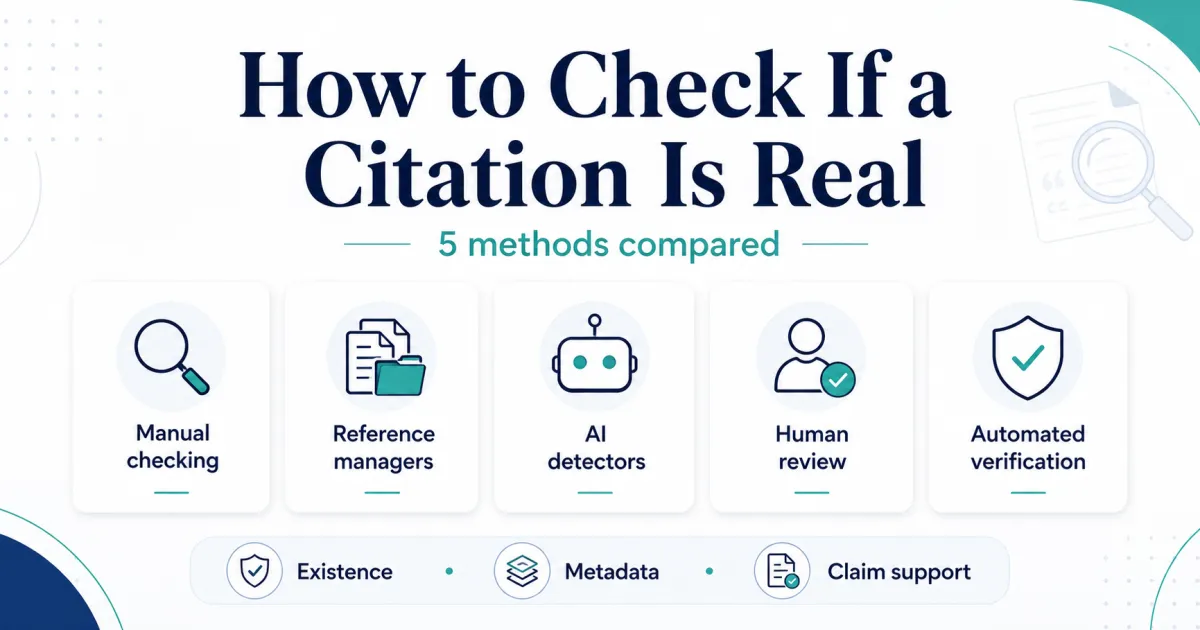
How to Check If a Citation Is Real: 5 Methods Compared
How to Check If a Citation Is Real: 5 Methods Compared
Manual checks, reference managers, AI detectors, human review, and automated citation verification — what each can and cannot tell you.
Disclosure first: we built Citation Risk, one of the tools discussed below. Read this knowing that. We’ve tried to describe every option fairly, including the situations where something other than our tool is the better fit. If we’ve gotten a detail about another service wrong, tell us, and we’ll correct it.
AI-assisted writing has created a new editorial chore: reference lists can no longer be assumed real. A recent Lancet analysis of 2.5 million biomedical papers found fabricated citations in published, peer-reviewed research — rising from roughly 1 in 2,828 papers in 2023 to 1 in 277 in early 2026 (Columbia University School of Nursing).
If fabricated references get through journal review, they can certainly get through a quick visual skim of a bibliography.
So how do you actually check? There are five main approaches, and they answer different questions. Here’s what each one does, what it costs, and where it breaks down.
First, be clear what “checking a citation” means
A citation can fail in four distinct ways, and no single method covers all of them:
Existence — does the cited source exist at all?
Metadata accuracy — do the authors, title, journal, year, and DOI match the real record, or is it a half-real citation: real author, wrong paper; real title, wrong journal?
Retraction status — the source exists but has been withdrawn.
Claim support — does the source actually say what the text claims it says?
The fourth one matters most and automates least.
No tool — ours included — can prove that a source supports a specific claim. That requires a human reading the source. Keep that boundary in mind when any product promises “complete accuracy”: existence and metadata can be checked against public records; relevance and support still require judgment.
Method 1: Manual checking
Manual checking is free, accurate when done carefully, and still the gold standard for a small number of important sources.
You can verify any single citation yourself in a few minutes:
Resolve the DOI. Paste it into doi.org. If it resolves, confirm the landing page matches the cited authors and title. AI-fabricated citations can attach a real DOI to the wrong paper.
Search the title in quotes on Google Scholar, Crossref, or PubMed for biomedical work. No hits on an exact-title search of a claimed journal article is a strong warning sign.
Check the journal’s own archive for the volume, issue, and pages cited.
Search the author plus a distinctive title phrase to catch half-real citations where the title is slightly rewritten.
This is the right method for a handful of references, and every writer should know it.
The problem is arithmetic. Done properly, each citation can take 3–5 minutes. A 50-reference bibliography becomes a half-day of careful lookup work. And the Lancet study’s origin story is instructive here: the researcher behind it studies AI hallucinations, checked his own references by hand, and still nearly missed a fabricated one.
Manual checking fails not because the method is wrong, but because attention degrades across repetition.
Use when: you have a small number of important sources to verify.
Not ideal for: long bibliographies, deadline pressure, or routine high-volume editorial work.
Method 2: Reference managers
Reference managers such as Zotero, EndNote, Paperpile, and similar tools are excellent at what they are built for: importing sources you found in real databases, keeping metadata tidy, and formatting bibliographies. Some can flag broken links or incomplete records.
But they verify provenance mostly by how the reference got in. If you imported a source from a trusted database, the source probably exists.
That is different from auditing a pasted list of unknown origin, which is exactly what an AI-generated bibliography often is. If the reference list arrived as plain text from a chatbot, client manuscript, or student draft, a reference manager mostly tells you whether the citation can be organized or formatted. It does not automatically prove that the reference is real.
Use when: you control the research workflow from the start.
Not ideal for: auditing a finished document’s references after the fact.
Method 3: Plagiarism and AI detectors
Plagiarism checkers and AI detectors answer different questions.
A plagiarism checker asks:
Does this text match existing text?
An AI detector asks:
Was this text likely machine-written?
Neither one checks whether reference 23 exists.
They appear in this comparison only because people often reach for them when they suspect AI involvement. But if your actual concern is the bibliography, a detector gives you a probability to argue about. A citation check gives you something concrete to discuss.
A fabricated reference is checkable against public records regardless of who — or what — wrote the prose around it.
Use when: your concern is text similarity or possible AI authorship.
Not ideal for: verifying whether citations are real, accurate, or complete.
Method 4: Human verification services
A newer category has emerged: human citation verification services. You submit a document, and a person or team checks each citation, returning a report on what appears valid, what needs correction, and what should be reviewed.
HalluGuard is one visible example of this category. Its public positioning emphasizes human review, document submission, and turnaround measured in days.
Fairly stated, the appeal is human sign-off. For a one-off, high-stakes document — a legal filing, regulatory submission, or important manuscript — where you want to be able to say that a person reviewed every reference, a manual service can deliver reassurance in a way automation does not.
The trade-offs are structural. Turnaround measured in days does not fit a submission deadline tomorrow or an editor turning around client work weekly. Per-document human labor is also priced accordingly at volume.
One caution applies to the whole category: citation verification and claim-support verification are not the same thing. A human checker can verify existence and metadata faster than they can verify that every cited source supports every specific claim attached to it. That last mile belongs to the author, reviewer, or reader in every workflow.
Use when: you have one high-stakes document, lead time, and want human review.
Not ideal for: speed, volume, or routine pre-submission checks.
Method 5: Automated citation verification
Automated citation verification tools take a reference list and check each citation against public bibliographic records, such as DOI registries, Crossref, PubMed, and other scholarly indexes.
Citation Risk is one tool in this category.
The purpose is to answer the first two questions from the framework:
Does this source appear to exist?
Does the metadata match the public record?
That means checking details such as authors, title, journal, year, publisher, DOI, and source match.
What distinguishes tools in this category is how they handle uncertainty. Citation Risk returns one of six verdicts per reference:
Verified
The source appears to exist and key metadata matches.
Review
Possible match or ambiguity needs human checking.
Mismatch
A likely source was found, but supplied details do not match the public record.
Not Found
No reliable matching source was found. This does not prove the source does not exist anywhere.
Incomplete
Not enough citation data was supplied for reliable verification.
Lookup Limited
A lookup source was unavailable or limited, so the result should be reviewed.
The uncertainty matters. A checker that only ever says “real” or “fake” is asserting more certainty than bibliographic lookup can always support. Treat binary verdicts from any tool with caution.
The structural limits run the other way from human review. Automation is fast and scales to long bibliographies, but it does not provide human attestation. And the same boundary still applies: no automated check proves that a source supports a specific claim.
The honest role of an automated checker is triage: clear the existence and metadata question across all references quickly, so human attention goes where the verdict says it is needed.
Use when: checking reference lists before submission or delivery, especially at volume or on a deadline.
Not ideal for: claim-support certification or formal human sign-off.
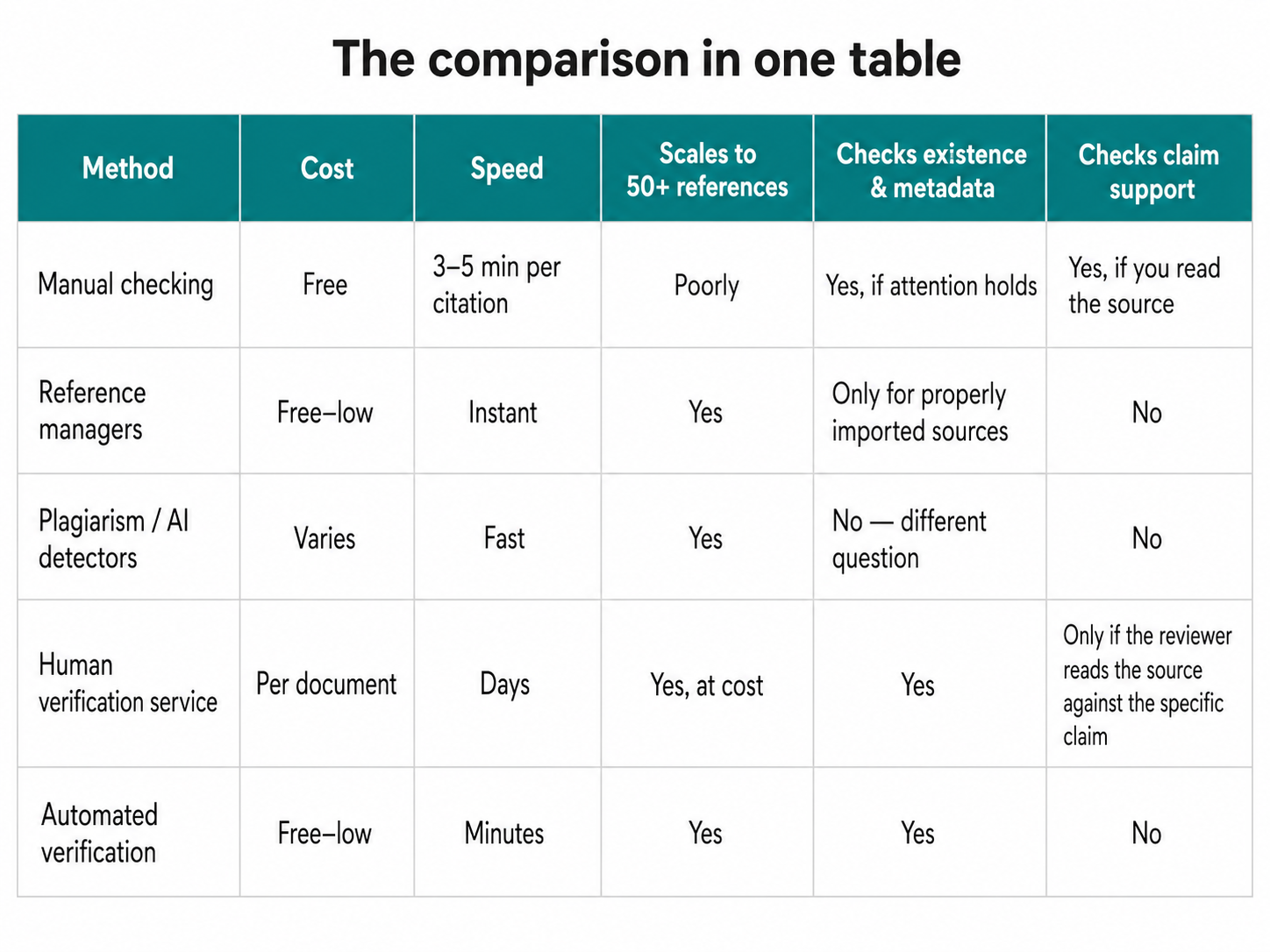
The last column is the important one. Claim support is not the same as citation existence. A real source can still be used badly. A correct DOI can still be attached to a weak argument. That part still requires reading.
Which method should you use?
A student or researcher with a deadline this week:
Run an automated check of the full reference list, then manually read the sources behind your load-bearing claims.
An academic editor delivering client work:
Use automated citation verification as a standard pre-delivery step. The arithmetic of manual checking does not survive a weekly client load. Follow up manually on anything flagged Review, Mismatch, Not Found, Incomplete, or Lookup Limited.
A one-off, high-stakes document with lead time:
Use a human verification service, or run automated triage first and send only flagged items for deeper human review.
Building a bibliography from scratch:
Use a reference manager and import only from real databases. The cheapest verification is never letting an unverified reference in.
Whatever the workflow, the timing matters more than the tool. Every one of these checks is cheaper before submission than after. A fabricated reference found at your desk costs a correction. Found by a reviewer, a client, or a reader, it costs credibility.
Try the automated version on your own list
Paste a reference list into Citation Risk and check up to 50 citations free, no card, no paper upload, no AI detector guessing.
See what matches, what fails, and what needs review before the document leaves your desk.
Citation Risk checks citation existence and metadata accuracy. It does not prove that a source supports a specific claim.