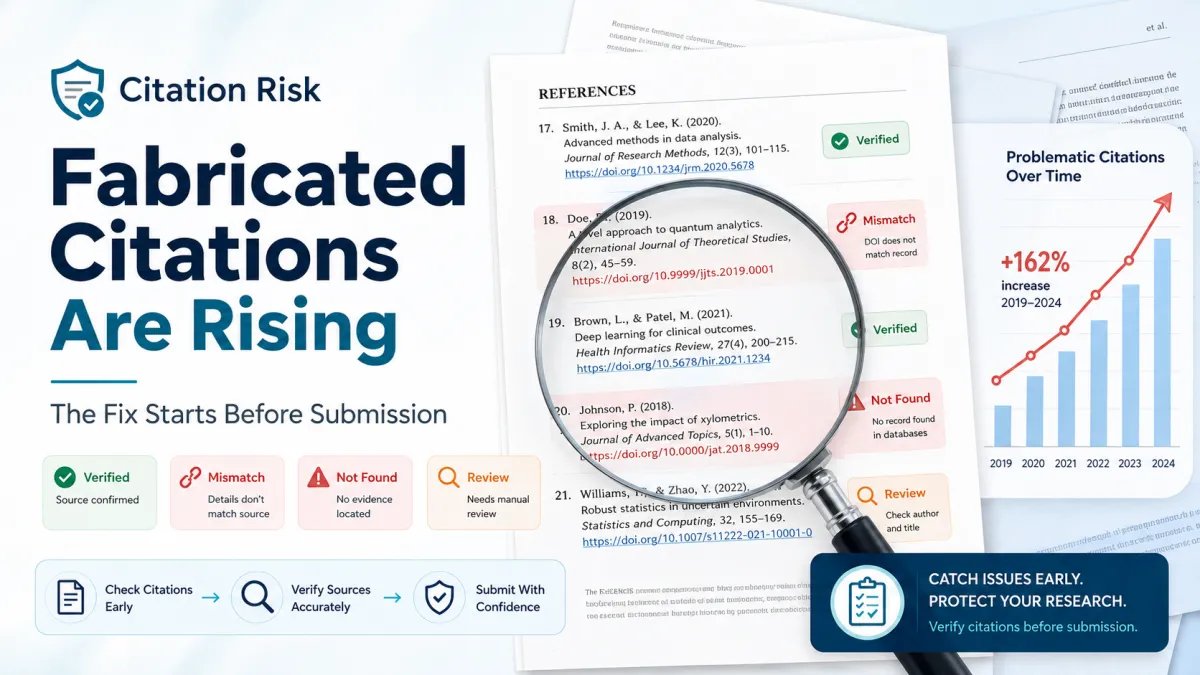
Fabricated Citations Are Rising. The Fix Starts Before Submission
A Lancet study of biomedical papers shows why citation verification needs to happen before a document leaves your desk.
Fabricated citations are no longer a hypothetical risk of AI-assisted writing. They are now measurable in published biomedical literature, not in student essays, not in blog posts, but in peer-reviewed journals.
The question this raises is not "who is writing with AI?" It is a more practical one: at what point in the writing and review process should references actually be checked? The new evidence suggests the answer is earlier than most workflows currently allow.
What the Lancet study found
Maxim Topaz, a Columbia University researcher who studies AI hallucinations, nearly published a fabricated citation himself. The reference looked real. He had checked his bibliography by hand. The journal's editorial team caught it before publication.
That near-miss led to a systematic study. Topaz and colleagues, publishing in The Lancet, analysed around 2.5 million biomedical papers and 97.1 million references. They found 4,046 fabricated citations across 2,810 papers (Columbia University School of Nursing).
The trend matters more than the totals. The rate of papers containing at least one fabricated reference rose from roughly 1 in 2,828 papers in 2023, to 1 in 458 in 2025, to 1 in 277 in the first seven weeks of 2026.
The absolute numbers are still small relative to the literature as a whole. The direction is hard to ignore.
Coverage of the study is also available from STAT.
What a fabricated citation actually is
A fabricated citation is a reference that looks like a real academic citation but points to no traceable publication. It typically has all the right parts, plausible authors, a plausible title, a real journal name, a volume, pages, sometimes a DOI, assembled into a source that does not exist.
That is what makes them hard to catch. Fabricated citations are not sloppy. They are well-formatted. APA compliance tells you nothing about whether the source is real.
And the fully fabricated citation is only one version of the problem. Many risky references are half-real: a genuine author attached to a paper they never wrote, a real title with the wrong journal, a DOI that resolves to a different article entirely. Those that pass a quick visual check even more easily.
The failure point is not publication. It is everything before it.
The most instructive detail in this story is not the numbers. It is that - a researcher who studies AI hallucinations, checking his own references by hand, still nearly missed one.
If careful manual review by a subject-matter expert is not reliable at catching these, then the current default workflow, write, format, skim the bibliography, submit, has a gap in it. And the gap sits before submission:
Before a manuscript goes to a journal
Before an editor delivers a document back to a client
Before a thesis goes to a committee
Before a report leaves someone's desk
Once a fabricated reference is published, the damage does not stay in one bibliography. Citations are the traceability layer of research. A reference that leads nowhere can flow into literature reviews, editorial decisions, and evidence synthesis. It is far cheaper to catch before submission than to explain afterward.
Where Citation Risk fits
This is the problem Citation Risk is built for.
Citation Risk is not an AI detector. It does not guess whether a human or a model wrote the text. It is also not a citation formatter; formatting was never the issue.
It is a citation verification tool. Paste a reference list, and Citation Risk checks whether each citation appears to exist and whether its key metadata, authors, title, journal, year, DOI matches public bibliographic records.
Each reference comes back with one of six verdicts: Verified, Review, Mismatch, Not Found, Incomplete, or Lookup Limited. The verdicts are deliberately honest about uncertainty. A Not Found means no reliable matching source was found — it does not prove the source doesn't exist anywhere. A Review or Lookup Limited tells you where human judgment is still needed rather than pretending the question is settled.
One boundary worth stating plainly
Citation Risk checks citation existence and metadata accuracy. It does not prove that a source supports a specific claim. Whether a real, correctly cited paper actually says what the author claims it says still requires a human reader. What Citation Risk does is clear the first hurdle: do these references exist, and do their details match the record, so that human attention goes where it is actually needed.
Check before it leaves your desk
The Lancet numbers describe what gets through to publication. The practical response is not panic. It is moving citation checking earlier in the workflow, before submission, before delivery, before the document leaves your desk.
Paste a reference list into Citation Risk and see what matches, what fails, and what needs review.
Try Citation Risk before the document leaves your desk.
Sources: The Lancet · Columbia University School of Nursing · STAT