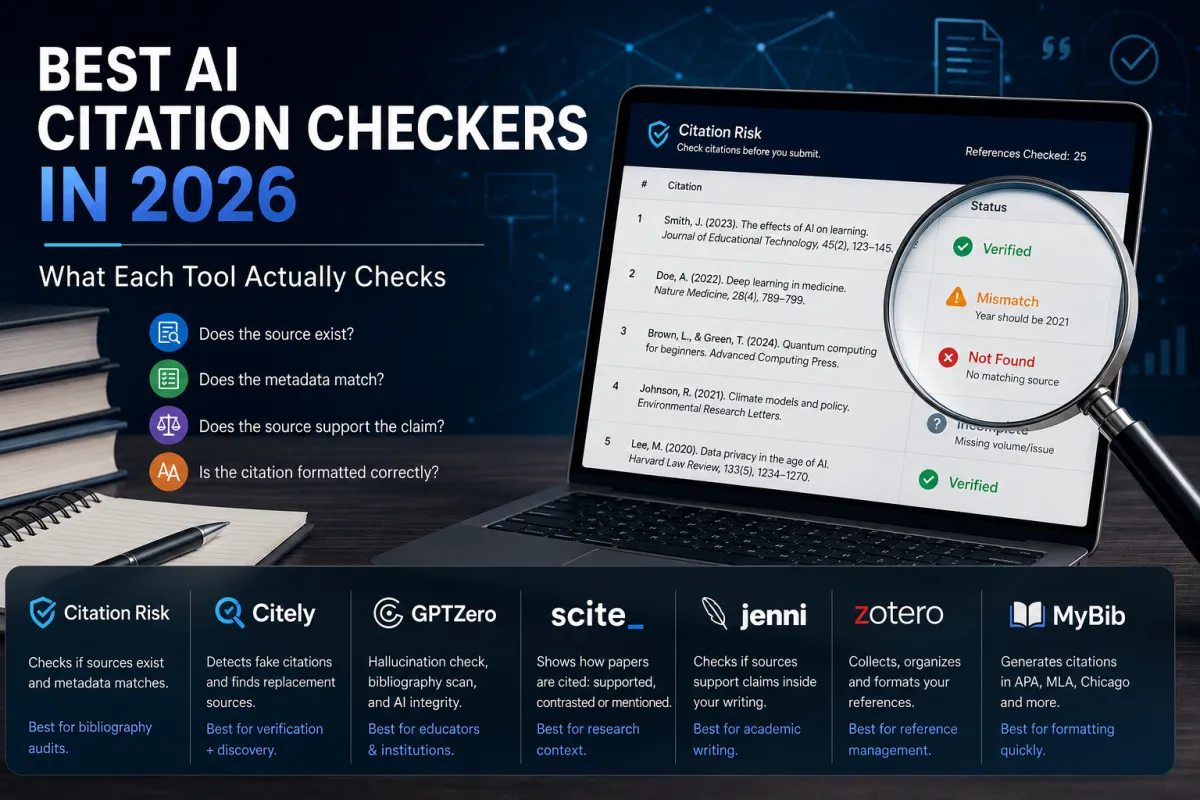
Best AI Citation Checkers in 2026: What Each Tool Actually Checks
AI-generated references can fail in several different ways.
A citation may point to a paper that does not exist. It may contain a real DOI attached to the wrong title. The paper may be genuine while the author, year or journal details are incorrect.
A reference can also be bibliographically accurate but fail to support the claim attached to it.
These are separate problems. They require different checks.
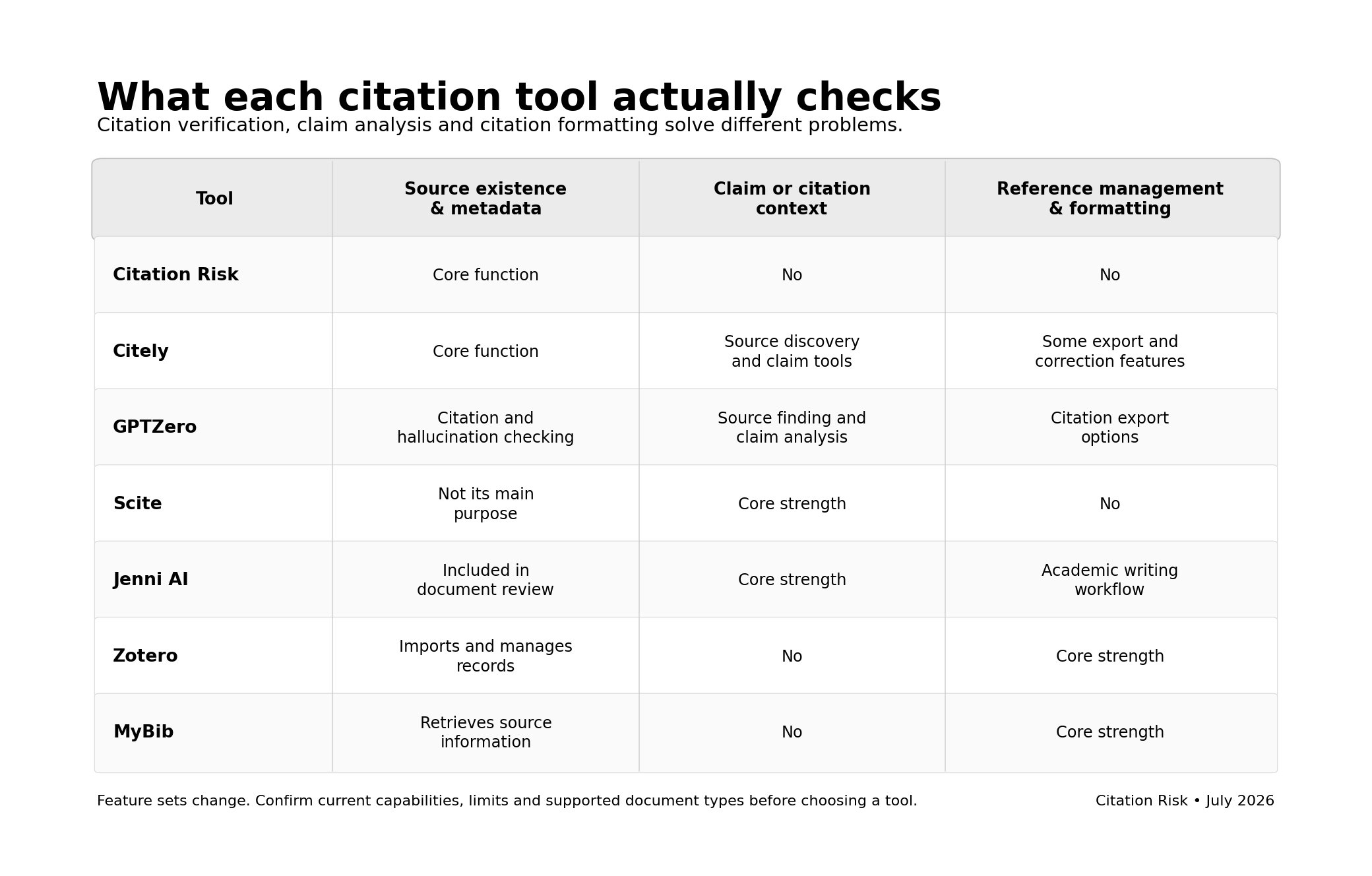
Some tools verify whether cited sources exist. Some compare citation metadata with bibliographic records. Others analyse whether a source supports or contradicts a claim. Reference managers and citation generators mainly organise and format bibliographies.
Calling all of these products “citation checkers” hides important differences.
This guide compares several prominent citation tools available in 2026 and explains what each one is designed to check.
Four different citation checks
Before choosing a tool, decide which question you need answered.
1. Does the cited source exist?
This is the most basic integrity check.
A fabricated citation may contain a plausible title, realistic author names and the name of a genuine journal while referring to no identifiable publication.
AI writing tools have made this problem more visible because they can generate references that look academically credible without corresponding to real sources.
2. Does the supplied metadata match the source?
Finding a similar paper is not enough.
A citation can point towards a genuine publication while containing an incorrect:
title
author
publication year
journal or venue
DOI
source link
A search result may look close to the supplied reference without proving that the reference itself is accurate.
3. Does the source support the attached claim?
A citation can be bibliographically correct and still be used incorrectly.
The cited paper may:
study a different population
reach a narrower conclusion
contradict the statement
provide only indirect evidence
be cited for something it did not test
Checking this requires analysis of the source content and the author’s claim. It is a deeper and more interpretive task than comparing bibliographic metadata.
4. Is the citation formatted correctly?
Formatting tools answer questions about APA, MLA, Chicago, Harvard and other citation styles.
They help create consistent bibliographies. They do not necessarily establish that a source exists, that its metadata is accurate or that it supports the author’s claim.
A perfectly formatted fake citation is still fake.
Comparison at a glance
Citation Risk: focused bibliography verification
Citation Risk is designed to answer two questions:
Does the supplied citation correspond to an identifiable source?
Do its important bibliographic details match reliable external records?
Users paste references rather than uploading an entire manuscript. Each citation receives one of four verdicts:
Verified: The source exists and the important supplied metadata aligns with reliable records.
Mismatch: A likely source exists, but one or more supplied details conflict with the available record.
Not Found: No sufficiently reliable matching source was located.
Incomplete: Too little citation information was supplied for reliable verification.
Citation Risk checks details such as title, author, year, venue and identifiers. It takes a conservative approach: finding a vaguely similar paper should not automatically produce a Verified result.
Where Citation Risk is strongest
Citation Risk is particularly useful when:
an editor receives a bibliography containing unfamiliar references
a thesis coach wants to isolate questionable citations
a researcher has used an AI assistant during drafting
a document may contain real sources with incorrect metadata
the user wants to check references without uploading the complete manuscript
Its main distinction is the separation between source existence and citation accuracy.
A paper can exist while the supplied citation remains wrong.
What Citation Risk does not do
Citation Risk does not determine whether a paper supports the claim being made.
It also does not:
detect whether prose was written by AI
generate replacement references
replace a citation manager
correct APA or MLA formatting
assess the scientific quality of a study
Citation Risk is a pre-submission citation audit, not a full manuscript or claim validator.
Best suited to: Academic editors, thesis editors, thesis coaches, researchers and professional writers who need a focused check of citation existence and bibliographic metadata.
Citely: citation verification combined with source discovery
Citely describes itself as both an AI citation checker and a source finder.
Its citation checker compares details such as DOI, title, author, publication year and journal against sources including Crossref, PubMed, arXiv and OpenAlex. Its wider product also helps users search for academic sources relevant to claims or passages in their writing.
This gives Citely substantial overlap with dedicated citation-verification tools while extending the workflow into research discovery.
Where Citely is strongest
Citely may suit users who want several related functions in one product:
fake-reference detection
bibliographic verification
source discovery
help locating original or related sources
correction or export of reference information
Important distinction
Finding a relevant paper does not prove that the original supplied citation was correct.
Users should examine whether any tool clearly distinguishes between:
an exact bibliographic match
a probable or partial match
a newly suggested source
an unresolved citation
A replacement source may support the writer’s argument while having no bibliographic relationship to the original reference.
Best suited to: Users who want citation verification and academic source discovery in the same workflow.
GPTZero: citation checking within a broader document-integrity platform
GPTZero began as an AI-writing detection service but now provides citation, hallucination and source-analysis tools.
Its Hallucination Check analyses citations and presents information about the closest identified source, component-level similarity and the reason for its classification. GPTZero’s Source Finder also identifies checkable claims and searches for sources that may support or contradict them.
The platform combines these capabilities with services such as AI-writing detection and plagiarism checking.
Where GPTZero is strongest
GPTZero may be useful when an educator or institution wants several document-review functions together:
AI-writing detection
plagiarism analysis
citation checking
hallucination detection
claim identification
source suggestions
bibliography review
GPTZero has also published investigations in which it applied its citation tools to conference papers and professional reports.
Those investigations demonstrate how the company uses its system, but performance claims published by GPTZero should still be recognised as company-reported evidence rather than independent validation.
Important distinction
GPTZero is a broad platform rather than a dedicated bibliography-auditing product.
That breadth may be useful for institutions already using its other services. It may be unnecessary for an editor whose only task is to verify a reference list.
Best suited to: Educators and institutions that want citation checks alongside AI-writing detection, plagiarism analysis and wider document review.
Scite: understanding how research is cited
Scite addresses a different part of the citation problem.
Its Smart Citations classify citation statements according to whether later publications appear to support, contrast with or mention the cited research. Scite reports that it has indexed more than 1.6 billion citation statements.
This makes Scite valuable for investigating how a paper has been treated in the scientific literature.
It can help answer questions such as:
Has this finding been supported by later research?
Have other papers disputed it?
How is this source being cited?
Is the paper being relied upon or merely mentioned?
Where Scite is strongest
Scite is particularly useful for:
literature reviews
evidence assessment
research discovery
examining disputed findings
exploring citation context
identifying supporting and contrasting literature
What Scite is not primarily built for
Scite is not principally a bibliography-cleaning tool.
Its main strength is analysing citation relationships and research context, not assigning conservative metadata verdicts to every reference in a pasted bibliography.
A user investigating a fake title, incorrect year or fabricated DOI may still need a dedicated reference-verification tool.
Best suited to: Researchers who want to understand how later literature supports, contrasts with or mentions a study.
Jenni AI: claim-level review within an academic writing environment
Jenni AI combines academic writing tools with document-review features.
Its Claim Confidence review examines factual assertions and can flag claims described as unsupported, overstated, misattributed or contradicted. It also displays excerpts from relevant cited sources. Other review functions address source quality and citation-related concerns.
This places Jenni closer to claim and document analysis than narrow bibliography auditing.
Where Jenni is strongest
Jenni may suit someone drafting an academic document who wants to examine:
whether a cited source supports a sentence
whether a claim overstates the evidence
whether a source contradicts the text
whether a claim has been misattributed
whether wording or citation placement needs revision
Important distinction
Claim analysis is more interpretive than metadata verification.
A metadata checker can compare a supplied publication year with an external bibliographic record. Determining whether a paper supports a nuanced claim requires judgement about language, scope, methods and evidence.
Claim-level results should therefore assist professional review rather than replace it.
Best suited to: Writers who want citation and claim analysis integrated into an academic drafting environment.
Zotero: collecting, managing and formatting references
Zotero is a reference manager rather than a dedicated fake-citation detector.
It helps users collect, organise, annotate and cite research. It can generate in-text citations and bibliographies in Word, LibreOffice, Google Docs and other writing environments.
Where Zotero is strongest
Zotero is useful for:
maintaining a research library
saving source metadata
organising PDFs and notes
inserting in-text citations
changing citation styles
generating bibliographies
synchronising research collections
What Zotero does not guarantee
A reference manager works with the records it receives.
Metadata imported from a webpage, database, catalogue, identifier lookup or manual entry may still contain errors. Zotero makes the record easier to store, organise and format. It does not establish that every imported detail is correct or that the source supports a claim.
A sensible workflow is:
verify questionable references
correct the metadata
store and format the corrected records in Zotero
Best suited to: Researchers who need long-term reference management and bibliography formatting.
MyBib: generating formatted citations quickly
MyBib is a citation and bibliography generator.
Users can search for a source or enter an identifier and create references in styles such as APA, MLA, Harvard and Chicago.
Where MyBib is strongest
MyBib is useful when:
the source is already known
the user needs a formatted citation quickly
a bibliography must be converted into another style
the main task concerns punctuation, order and presentation
What MyBib does not primarily answer
Citation generation is not the same as citation verification.
A generator may retrieve source information and format it correctly, but its principal function is not to conduct a conservative investigation into whether each supplied reference is fabricated, mismatched or incomplete.
Best suited to: Students and writers who need straightforward citation formatting.
Which citation checker should you choose?
The appropriate tool depends on the failure you are trying to prevent.
Choose Citation Risk when:
you already have a reference list
you need to check whether citations correspond to real sources
you want to identify incorrect titles, authors, years, venues or identifiers
you do not want to upload the full manuscript
you want clear, evidence-based verdicts
Choose Citely when:
you want citation verification and source discovery together
you may need help locating original or related sources
you prefer a broader research workflow
Choose GPTZero when:
citation checking forms part of an AI-integrity or grading workflow
you also need AI-writing or plagiarism analysis
you are reviewing full documents rather than only bibliographies
Choose Scite when:
the source is real, but you want to understand how later studies treat it
you need supporting, contrasting or mentioning citation context
you are conducting a literature review
Choose Jenni AI when:
you are writing inside an AI-assisted academic environment
you want claims compared with their cited sources
you need help finding unsupported, contradicted or overstated statements
Choose Zotero or MyBib when:
your sources are already established
your main problem is organising or formatting references
you need a citation style applied consistently
A practical citation-integrity workflow
No single tool performs every citation task equally well.
A safer workflow separates the stages.
Step 1: Audit the references
Check whether each source exists and whether the supplied title, author, year, venue and identifier match reliable records.
Citation Risk or another dedicated bibliography checker can assist at this stage.
Step 2: Resolve questionable results
Manually inspect references marked Mismatch, Not Found or Incomplete.
Do not replace a failed citation with the first vaguely similar paper returned by a search tool.
Step 3: Check important claims
Read the cited source and confirm that it supports the statement for which it is being used.
Scite, Jenni and other claim-context tools can assist, but the final judgement may still require subject knowledge and human review.
Step 4: Correct and organise the records
Update the corrected records in Zotero or another reference manager.
Step 5: Format the bibliography
Apply the required journal, university or publication style after the underlying references have been checked.
Formatting should be the final layer, not the first.
The distinction that matters
A citation can fail at several separate layers:
The source may not exist.
The source may exist, but the supplied metadata may be wrong.
The citation may be accurate, but the source may not support the claim.
The source, metadata and claim relationship may all be sound while the formatting remains inconsistent.
These failures should not be merged into one vague citation-accuracy score.
A trustworthy tool should explain which layer it has checked, what evidence it found and what remains unresolved.
Final assessment
There is no universal best citation checker.
Citation Risk provides focused checks of source existence and bibliographic metadata.
Citely combines reference verification with broader source-discovery features.
GPTZero places citation and hallucination checking inside a wider document-integrity platform.
Scite is strongest when users need to understand how research has been supported, contrasted with or mentioned by later literature.
Jenni AI focuses on claim and citation review within an academic-writing environment.
Zotero and MyBib are most useful for organising and formatting references after their underlying accuracy has been established.
The useful question is not simply:
Which citation checker is best?
It is:
What exactly do I need checked?
Once that is clear, the appropriate tool becomes much easier to identify.