AI Fabricated References: 5 Citation Problems to Check Before Submission
AI tools can help you draft faster, summarise faster, and organize research faster.
But there is one place where they can quietly wreck your credibility:
references.
A citation can look professional, follow the right academic style, include a journal name, list plausible authors, and still be wrong.
That is the danger of AI-fabricated references. They often do not look obviously fake. They look close enough to pass a quick glance — until someone checks them.
Before a thesis, dissertation, article, report, or edited document leaves your desk, these are the five citation problems worth checking.
1. The source does not exist
This is the clearest form of fabricated reference.
The citation looks real, but no matching source can be found in reliable bibliographic databases. The title may sound academic. The authors may sound plausible. The journal may exist. But the actual paper, chapter, or book cannot be verified.
Example warning signs:
The title is very generic.
The author names look plausible but do not match the topic.
The journal exists, but not that article.
The DOI is missing, broken, or points nowhere.
Search results only show AI-generated pages, not the original source.
This is the classic “AI hallucinated citation” problem.
The risk is simple: if the reference does not exist, the document immediately loses credibility.
2. The source exists, but the metadata is wrong
This one is more subtle.
The source may be real, but the citation contains incorrect details. That might include the wrong year, wrong author, wrong title, wrong journal, wrong volume, wrong issue, wrong page range, or wrong DOI.
This matters because a real source with wrong metadata is still a citation risk.
For example:
A paper exists, but it was published in 2018, not 2021.
The DOI belongs to a different article.
The title has been altered.
The journal name is wrong.
The author list has been mixed with another source.
This is why “the source exists” is not enough.
A citation should be checked for both existence and accuracy.
3. The reference is incomplete
Sometimes the problem is not that the citation is fake. It is that there is not enough information to verify it confidently.
An incomplete reference may be missing:
author names
publication year
title
journal or publisher
DOI
URL
page range
volume or issue number
Incomplete references are especially common when AI tools generate rough bibliographies, when students paste partial references, or when editors receive documents with inconsistent reference formatting.
An incomplete citation creates uncertainty.
It may be real. It may be wrong. But without enough information, it cannot be checked properly.
That uncertainty should be fixed before submission.
4. The citation points to the wrong source
This is one of the nastier problems.
The citation may include a DOI or URL that works, but it leads to a different source than the one listed in the reference.
That means the reference looks verifiable at first glance, but the details do not match.
For example:
The DOI opens a real article, but the title is different.
The URL leads to a journal page, but not the cited paper.
The author names do not match the source found.
The publication year or journal metadata conflicts with the supplied citation.
This is dangerous because it can create false confidence.
A link that works is not the same as a correct citation.
5. The source exists, but it may not support the claim
This is a separate issue from citation verification, but it is important to understand.
A citation can be real and accurately formatted, but still not support the sentence or argument it is attached to.
For example:
The cited paper discusses the topic generally, but does not prove the claim.
The source is about a different population, method, or context.
The citation is being used too strongly.
The source says something narrower than the document suggests.
The citation is real, but irrelevant.
This is not the same as checking whether a reference exists.
Citation Risk currently checks whether references appear to be real, complete, and metadata-accurate. It does not yet prove that a source supports a specific claim.
That distinction matters.
First, check whether the citation exists and is accurate.
Then, for higher-stakes work, check whether the source actually supports the argument.
Why this matters before submission
Citation errors are not small formatting mistakes.
They can make a document look careless, rushed, or AI-generated in the worst possible way.
For students, this can damage trust with supervisors or examiners.
For thesis coaches and dissertation consultants, it can create awkward last-minute problems.
For academic editors, it can mean a document leaves your desk with hidden credibility risks.
For researchers and writers, it can turn a polished draft into a reputational problem.
The most dangerous citation problems are not always obvious.
They are the references that look fine until someone checks them.
What to check before a document leaves your desk
Before submission, review the reference list for these five risks:
Does the source actually exist?
Do the title, authors, year, journal, and DOI match?
Is the reference complete enough to verify?
Does the DOI or URL point to the correct source?
Does the source actually support the claim being made?
Citation Risk helps with the first four checks.
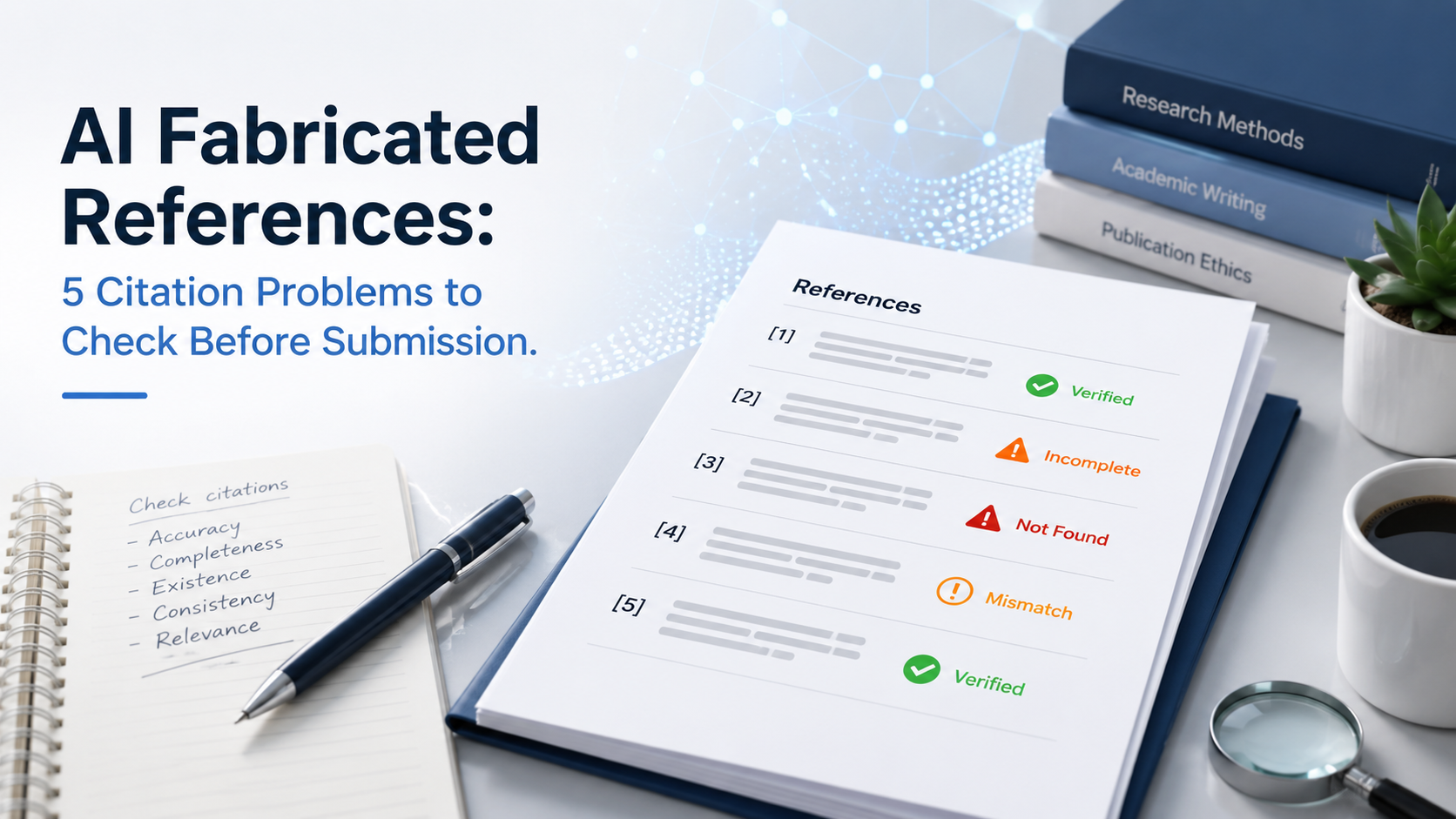
It gives each reference a clear status:
Verified — the source appears to exist and key metadata matches.
Mismatch — a source may exist, but important citation details do not match.
Not Found — no reliable matching source was found.
Incomplete — the reference does not contain enough information for confident checking.
Check citation risk before submission
AI-generated references can look convincing even when they are fake, broken, mismatched, or incomplete.
Before a thesis, dissertation, article, report, or edited document leaves your desk, check the references.
It is faster to catch citation risk now than to explain it later.
Check citation risk before a document leaves your desk.