AI Citation Checkers Are Not AI Detectors And That's the Point
AI Citation Checkers Are Not AI Detectors, And That's the Point
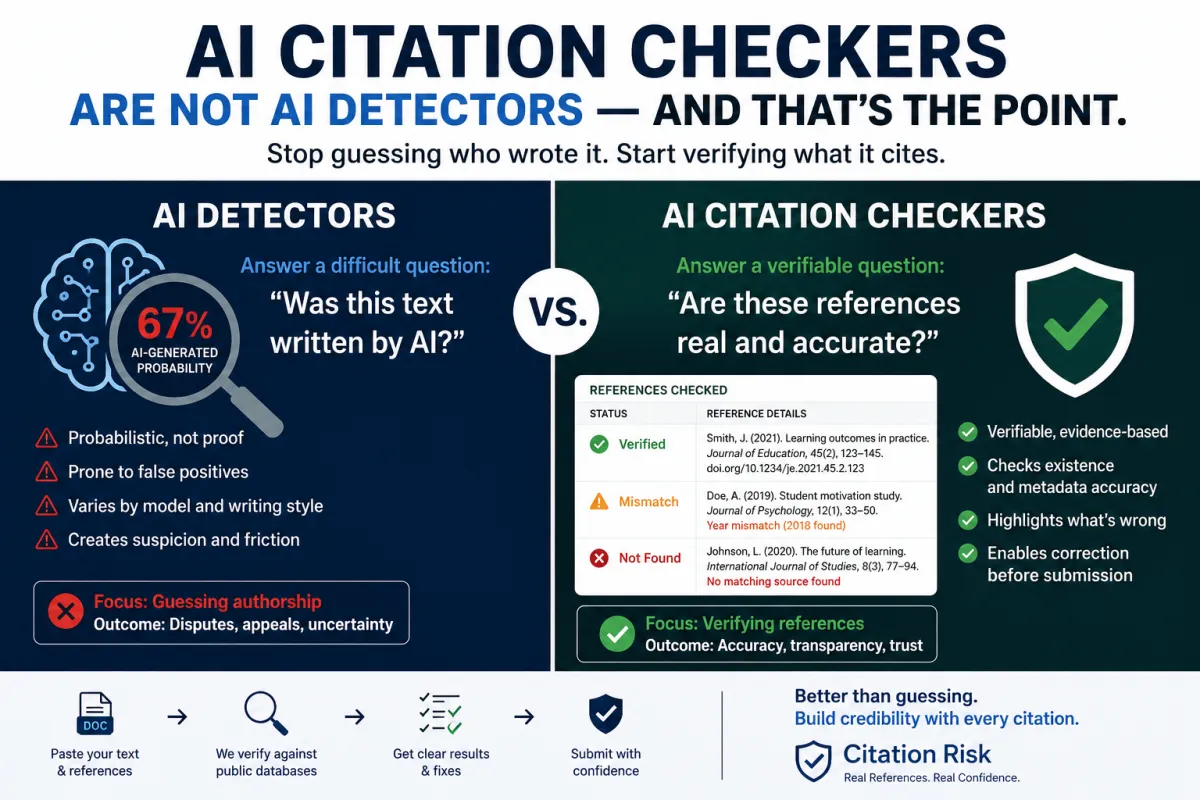
Instead of guessing whether text was written by AI, verify whether the references are real.
Picture the meeting. A detector has flagged a student's essay at 34% AI. Now there's a hearing, a defensive explanation, an appeal, and a lingering question nobody can actually answer: was this written by AI?
That question is genuinely hard to prove from the text alone, and the tools built to answer it say so themselves.
There's a better first question, and it doesn't require accusing anyone of anything: are these references real, and do their details match public records?
That's the difference between an AI detector and an AI citation checker. One guesses at authorship. The other verifies the evidence trail.
Detection Is a Probability Problem
AI detectors analyse writing patterns, phrasing, predictability, statistical regularity. But writing is messy. Human prose can look predictable; AI-assisted prose can be heavily human-edited; a non-native English speaker writing in careful, standardized academic style can look suspiciously "AI-like."
This isn't an outside criticism, it's the vendors' own position. Turnitin's guidance states plainly that false positives are a possibility, that scores below 20% are suppressed because they carry a higher likelihood of false positives, and that its indicator should not be used as the sole basis for adverse action against a student. Peer-reviewed research agrees: a 2026 study in the International Journal for Educational Integrity evaluating GPTZero, Pangram, Copyleaks and Turnitin found detection reliability breaks down on hybrid and humanised text (Van Vlasselaer et al., 2026), and a second 2026 study in the same journal concluded that detectors should serve only as indicators prompting further inquiry, never as sole grounds for a misconduct decision (Hadra et al., 2026).
None of this makes detectors useless. It makes them probabilistic, a signal, not a verdict. Treating a probability like courtroom evidence is how institutions end up litigating their own tools.
Citation Checking Is an Evidence Problem
Citation verification starts somewhere cleaner. A DOI either resolves to the article described, or it doesn't. The supplied title, authors, year, and journal either match the public record, or they don't. Ambiguity exists, incomplete references, messy formatting, but the task is concrete in a way authorship-guessing never will be.
And it targets the actual risk. The problem with AI-assisted writing was never merely that AI was involved. It's that AI can generate references that look credible while being fabricated, mismatched, or broken, a student unknowingly submits an invented bibliography; a researcher's AI-accelerated literature review carries wrong metadata; a report's DOIs collapse the moment a reader clicks them. (A source can exist while the citation attached to it is still wrong, we've dissected that failure mode, the half-real citation, in its own post.)
So instead of an accusation nobody can prove
"This looks like AI."
a citation checker returns findings anyone can act on:
"This DOI resolves to a different article." "This title doesn't match the source found." "This reference is incomplete."
That is the difference between suspicion and correction.
Suspicion produces meetings. Correction produces a fixed bibliography.
Verdicts, Not Vibes
A serious citation checker distinguishes failure types, because different failures demand different next steps. Citation Risk returns six verdicts:
Verified, the source appears to exist and key metadata matches. Mismatch, a likely source was found, but supplied details are wrong; correct them. Not Found, no reliable matching source was located in the records checked; replace or remove. Incomplete, not enough information to verify confidently; get more. Review, the evidence is genuinely ambiguous and a human should decide. Lookup Limited, the databases couldn't be fully queried this time.
Notice what the last two are: admissions of uncertainty. A verification tool that fakes confidence would be repeating the exact sin of the detectors.
The Grown-Up Workflow
AI use in writing is no longer fringe, and the research consensus points to integration with verification rather than a detection arms race. A workable AI-era workflow: use AI transparently where allowed; verify every citation; correct mismatches and remove what can't be verified, before submission; then, where stakes demand it, check whether the cited sources actually support the claims made.
That last step matters and deserves its own honesty: citation checking is not claim checking. A paper can exist, be cited perfectly, and still be misrepresented by the sentence citing it. Citation Risk checks existence and metadata accuracy; it does not claim that an accurate citation proves the source supports the argument. That's a deeper layer, but one you can't reach until the first gate is passed.
The Bottom Line
Detectors ask a question that's hard to prove and easy to weaponise: was this written by AI? Citation checkers ask a question that can actually be answered: do these references hold up?
A document doesn't become trustworthy because it sounds human. It becomes trustworthy when its sources can be checked.
No drama. No guessing game. Just check the trail.
Citation Risk is in early beta, paste a reference list at citationrisk.com and see the verdicts for yourself, before the document leaves your desk.
References
Hadra, M., Cambridge, K., & Mesbah, M. (2026). Evaluating the accuracy and reliability of AI content detectors in academic contexts. International Journal for Educational Integrity, 22(4). https://doi.org/10.1007/s40979-026-00213-1
Turnitin. Using the AI Writing Report. Turnitin Guides. https://guides.turnitin.com/hc/en-us/articles/22774058814093-Using-the-AI-Writing-Report
Van Vlasselaer, M., Van Droogenbroeck, F., & Spruyt, B. (2026). Who wrote this? Evaluating the reliability of AI detection tools in higher education. International Journal for Educational Integrity, 22(16). https://doi.org/10.1007/s40979-026-00226-w