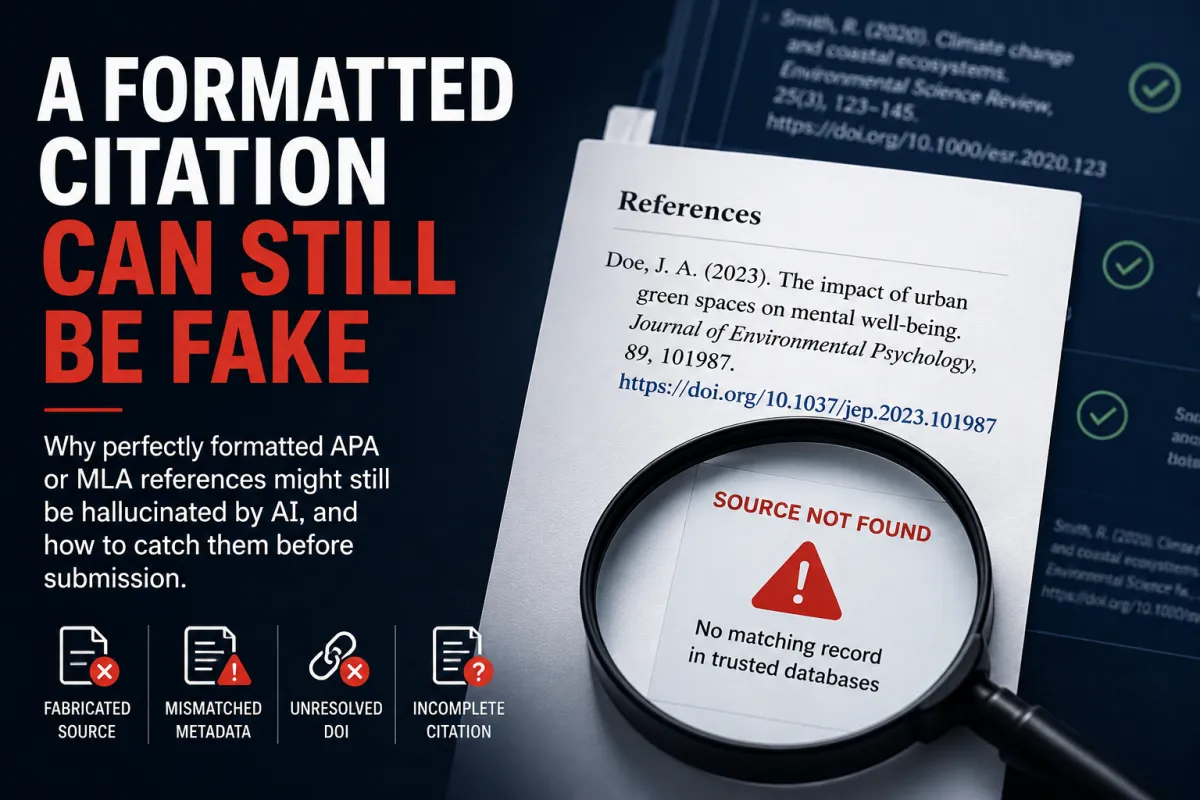
A Formatted Citation Can Still Be Fake
Why perfectly styled APA or MLA references may still be hallucinated by AI, and how to catch them before submission.
A bibliography can look perfect and still be wrong.
That is the uncomfortable truth many students, researchers, editors, and content teams are now facing. AI tools can generate references that look polished, academic, and properly formatted. The commas are in the right places. The journal titles are italicized. The DOI looks convincing. The citation style appears correct.
But formatting is not verification.
A citation can follow APA, MLA, Chicago, or Harvard style beautifully and still point to a source that does not exist.
The Illusion of Accuracy
Citation formatting creates a powerful illusion. When a reference looks professional, our brains tend to treat it as credible. We see the author name, year, title, journal, volume, issue, page range, and DOI, and we assume the citation must have come from somewhere real.
That assumption used to be safer.
Before AI-generated writing became common, most fake citations came from human error, careless copying, or poor source management. Now the problem has changed. AI systems can produce references that are not merely misformatted, but entirely fabricated.
They do not always “retrieve” a citation from a database. Sometimes they generate something that statistically resembles a citation.
That is where the danger begins.
How AI Hallucinates References
Large language models are designed to produce plausible language. When asked for academic references, they may generate text that looks like the kind of reference that should exist.
This can lead to several types of citation risk.
A fabricated source is the most obvious case. The author, title, journal, year, and DOI may all be invented. Nothing exists behind the reference except convincing academic-looking text.
A metadata mismatch is more subtle. The source may exist, but the details are wrong. A real author may be paired with a fake title. A real journal may be combined with the wrong year. A real DOI may belong to a completely different article.
An unresolved DOI is another common issue. The DOI follows the correct pattern, but it does not resolve to a real record. It looks technical enough to pass a quick scan, but it leads nowhere.
There are also incomplete citations. These may contain too little information to verify confidently. They may include an author and year, but no title. Or a title without enough publication data. These are not necessarily fake, but they are risky because they cannot be checked reliably without further information.
The danger is not only that AI invents sources. The danger is that it invents them in the exact shape people expect real sources to have.
Why Manual Checking Fails
Most manual citation checks focus on style compliance.
Are the references alphabetized?
Is the indentation correct?
Are titles capitalized properly?
Are journal names italicized?
Is the DOI presented in the right format?
Those checks matter, but they do not answer the most important question:
Does this source actually exist, and do the citation details match the public record?
That question is harder to answer by eye.
A fake citation can pass a formatting check easily. A mismatched citation can look legitimate until someone searches the title, DOI, journal, or author record. A wrong year may not be obvious unless the reference is compared against bibliographic databases.
This is why citation hallucinations often survive until late in the process: after submission, during peer review, in editorial checks, or worse, after publication.
By then, the problem is no longer just an error. It is a credibility issue.
A Real Source Can Still Be a Bad Citation
There is another trap here.
Finding a real source does not automatically mean the citation is correct.
A citation can point to a real article while still containing incorrect metadata. The title may be slightly wrong. The author list may be incomplete. The journal name may be inaccurate. The DOI may belong to another paper. The year may be off by one or more years.
That matters because academic references are not decorative. They are traceability infrastructure.
A reader should be able to move from your citation to the exact source you used. If the citation points vaguely toward something real but not accurately enough to confirm it, the reference is still a problem.
This distinction is essential:
Source existence asks: does something like this source exist?
Citation accuracy asks: do the supplied details match the actual source?
A proper citation checker must separate those two questions.
What Citation Risk Checks
Citation Risk is built for this specific problem.
It does not simply reformat references. It audits them.
The tool checks whether a citation appears to correspond to a real public bibliographic record and whether key metadata matches. That includes details such as title, authors, year, journal or venue, publisher, DOI, and available database records.
The goal is simple: help users see which references are safe, which are suspicious, and which need correction before submission.
Citation Risk uses clear result categories:
Verified means the source appears to exist and key metadata matches.
Mismatch means a possible source was found, but one or more supplied details do not match the public record.
Not Found means no reliable matching source was found.
Incomplete means the citation does not contain enough information for confident verification.
This gives users a practical next step instead of a vague warning.
What Citation Risk Does Not Claim
Citation Risk checks citation existence and metadata accuracy.
It does not prove that a source supports the claim attached to it.
That is a different and deeper problem.
A source can exist. The citation can be accurate. But the paper may still not support the sentence it is being used to justify.
That kind of claim-support checking requires a separate layer of analysis: reading the source, identifying the claim, comparing the evidence, and evaluating whether the citation is being used honestly.
Citation Risk starts with the first necessary layer: making sure the references themselves are real and correctly described.
You cannot responsibly check whether a source supports a claim until you first know whether the source exists.
Why This Matters Now
AI-generated writing has made citation risk much easier to create and much harder to notice.
A student can submit an essay with fake references without realizing it.
A researcher can include AI-assisted citations that were never checked.
An editor can review a clean-looking bibliography and miss fabricated sources.
A content team can publish a white paper with references that collapse under scrutiny.
The reputational cost is obvious.
Fake or broken citations make the whole document look careless, even when the main argument is sound. They create doubt where there may not have been any. They give critics an easy target. They turn a fixable reference problem into a trust problem.
And the worst part is that the damage is avoidable.
The Audit Trail Solution
The answer is not to stop using AI.
The answer is to stop trusting formatting as proof.
Every AI-generated or AI-assisted bibliography should be checked before submission, publication, or delivery. Not just styled. Not just cleaned. Checked.
A useful citation audit should show:
What citation was supplied.
What source was found.
Which metadata matched.
Which metadata failed.
Whether the DOI resolves.
Whether the source could not be found.
What the user should do next.
That audit trail gives the writer, editor, or researcher something more valuable than confidence.
It gives them evidence.
Before Submission Is the Moment That Matters
Citation errors are much easier to fix before submission than explain after delivery.
Before submission, a fake citation is a correction task.
After submission, it becomes a credibility problem.
Citation Risk exists for that before moment: the point where a student, researcher, writer, editor, or team still has time to catch the problem, correct the reference, replace the source, or remove the citation entirely.
A formatted citation can still be fake.
The only safe question is not “Does it look right?”
The safe question is:
“Can we verify it?”